
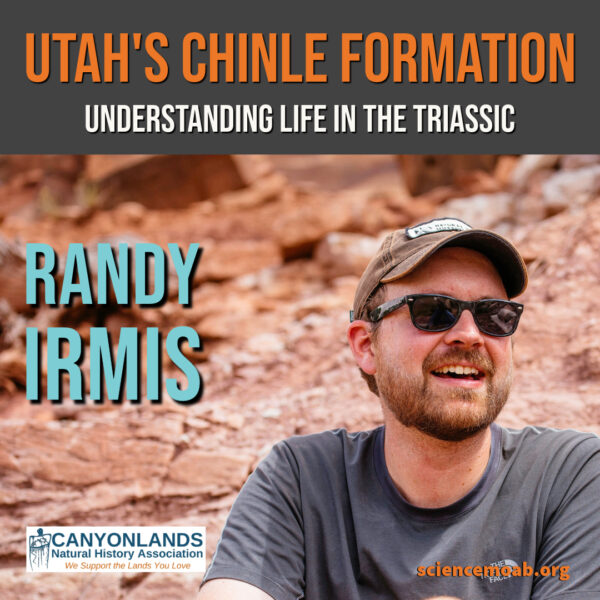
More than Just Uranium
Randy Irmis, a paleontologist and curator at the Natural History Museum of Utah, discusses his research on the Chinle Formation, (Triassic, ~201 to 230 million years ago) located in southern Utah. The Chinle Formation is characterized by river and stream deposits in a semi-arid environment, and is rich in fossils including vertebrates, plants, and trace fossils. Despite the historical lack of paleontological work in Utah compared to neighboring states, recent discoveries in the Chinle have significantly increased knowledge of life in the Triassic. We talk about the process of collecting and preparing these fossils for study and exhibits at the museum and Randy emphasizes the importance of public lands and the legal and ethical procedures for fossil collection and preservation.

Meet the Scientist: Randy Irmis
Randy Irmis is Curator of Paleontology at the Natural History Museum of Utah, and Professor in the Department of Geology & Geophysics, both part of the University of Utah, where he has worked since 2009. He received his BS in Geology (Emphasis in Paleontology) from Northern Arizona University in 2004, and his PhD in Integrative Biology from the University of California, Berkeley in 2008. While he was an undergraduate student, Randy spent three summers working as a paleontology intern and seasonal at Petrified Forest National Park. Randy’s scientific research asks how animals with backbones (and the larger ecosystems they lived in) evolved through deep time, particularly in response to climate change and other global events. This work investigates fossil ecosystems and environments that span in age from over 300 million years old to less than 10,000 years old, and has resulted in many years of fieldwork in Utah, New Mexico, Nevada, Arizona, Argentina, and Ethiopia.
Follow Science Moab wherever you get your podcasts


Interview Excerpt - Utah's Chinle Formation
 Today we are speaking with vertebrate Paleontologist Randy Irmis. Randy teaches at the University of Utah in the Department of Geology and geophysics, and is the curator of paleontology at the Natural History Museum of Utah. Some of Randy’s work involves studying fossils from the Triassic Chinle formation in Southern Utah, and comparing them with similar assemblages that have been found in the Chinle at different latitudes across the Colorado Plateau. The Triassic period ran roughly from 250 to 201 million years ago, and it followed the Permian Triassic Extinction event, the largest mass extinction in Earth’s history.
Science Moab: Can you describe what the environment was like during the time of the Chinle deposition?
Irmis: This formation has so many fossils in it because its sediments were deposited largely by rivers and streams and seasonal floods on floodplains and those are great places for fossils of plants and animals to get preserved because they tend to get buried quickly. This was a relatively dry river system, not unlike some parts of the southwest today, where sometimes of the year the rivers would have a lot of water going through them, but during the dry season, they were a lot smaller. So not as dry as a desert, but with very marked wet and dry seasons.
Science Moab: What sort of critters would’ve been living in these environments?
Irmis: this is a really exciting time because not only was there a mass extinction event at the end of the Triassic period, but there was also a mass extinction event at the beginning of the Triassic period. In the wake of that extinction event, there was lots of evolutionary experimentation going on with all these different life forms whose ancestors survived the extinction event, and then they’re diversifying and there’s lots of different things going on with both plants and animals.
I’m a vertebrate paleontologist, so that means I. Largely study animals with backbones. So we’ve got all different types of ray fin fishes in the rivers and streams. We have even freshwater Coelacanths, lobe fin fishes that are only found in the deep ocean today. There are large flathead amphibians whose heads and jaws look like toilet seat bowl covers. There were also a whole host of different types of reptiles.
Perhaps the most common reptile that we find fossils of is an animal called a phytosaur. And it’s very poorly named because phyto means plant, but these were most definitely meat eaters. They had very long snouts with lots of teeth, not unlike a crocodile or alligator but they’re not
related to modern crocodiles and alligators in any way. So they’re a great example of what we call convergent evolution, converging on the same body shape because of similar ecology and evolutionary pressures.
I could go on and on, but there are lots of other critters too. Really cool critters. But that’s just a sample.
Science Moab: You mentioned Arizona and New Mexico as type locales for species being discovered within the Chinle. Has not much been done with the Chinle in Utah before this study?
Irmis: Comparatively speaking, a lot less paleontological work had been done in Utah. There were some previous studies, don’t get me wrong, going back to the twenties, but compared to places like Northern New Mexico, places like Petrified Forest National Park in Arizona, and also similar aged sediments in West Texas, there’s tons of work done in those areas over the, the past a hundred twenty five, a hundred thirty years, and much, much less in Utah.
I can’t really completely say why that is, because when we think about the history of paleontology in general, Utah has a long and rich history of paleontological discovery here. But I think part of it might be that a lot of the areas where there’s good exposures of Chinle formation have historically been quite remote in southern Utah and difficult to get to. In addition, in the 1940s-1960s, there was a lot of mining activity going on in these areas as well.
Science Moab: You’ve been working with the Chinle Formation for close to 10 years now, can you tell us a bit about what you have found in terms of fossil assemblages?
Irmis: We’ve found a lot of different fossils, not only bones and teeth and skeletons, but also plant fossils, leaf fossils, as well as what we call trace fossils, like fossil footprints.
We’re really building up a picture of the entire series of ecosystems that’s preserved. One of the highlights is some of the fish fossils. most of the time in the Chinle formation you find lots of fish fossils, but they’re isolated scales and things like that. But we’ve found some amazing fish fossils where all the scales and bones are still in position. So they’re what we call articulated. So we can tell a lot about the different types of fin fishes and freshwater Coelacanths living during this time. There’s also some freshwater sharks that are living in these rivers and streams too.
We find a lot of fossils of the Phytosaur, the crocodile-like reptiles that have lots of teeth and pieces of bony armor and long snouts, and the Mesosaur, the flathead amphibians. We haven’t found any bones of dinosaurs, but we do have their footprints and we have footprints of some of these other reptiles as well that are preserved.
When we started working out in the Indian Creek area, there were maybe a handful of fossil sites that had been documented in the Chinle formation. I think we’re probably close to documenting over 300 sites now.


